
With Beecardia, recording an ECG has become the easy part. Reading it with confidence is where many of us still hesitate: Is this sinus arrhythmia or something that needs a closer look? Was that an early beat or an artifact?
The Beecardia ECG Academy is a new section of our website built to close that gap. It is built around a simple idea: the best way to become comfortable reading ECGs is to practice on real cases.
In a busy general practice, most ECGs are routine, and the unusual ones don’t come along often enough to build experience. The Academy gives you a place to practice whenever you have a few minutes - with real veterinary ECGs reported by veterinary cardiologists, immediate feedback, and explanations you can come back to when you need them.
The Academy is launching in beta, and it is open to everyone - no login required.
What Makes It Different
Textbooks show the perfect tracing. Your patients rarely do. Real ECGs come with motion artifacts, breed quirks, and rhythms that sit somewhere between "normal variant" and "call the cardiologist". The Academy is designed for exactly those:
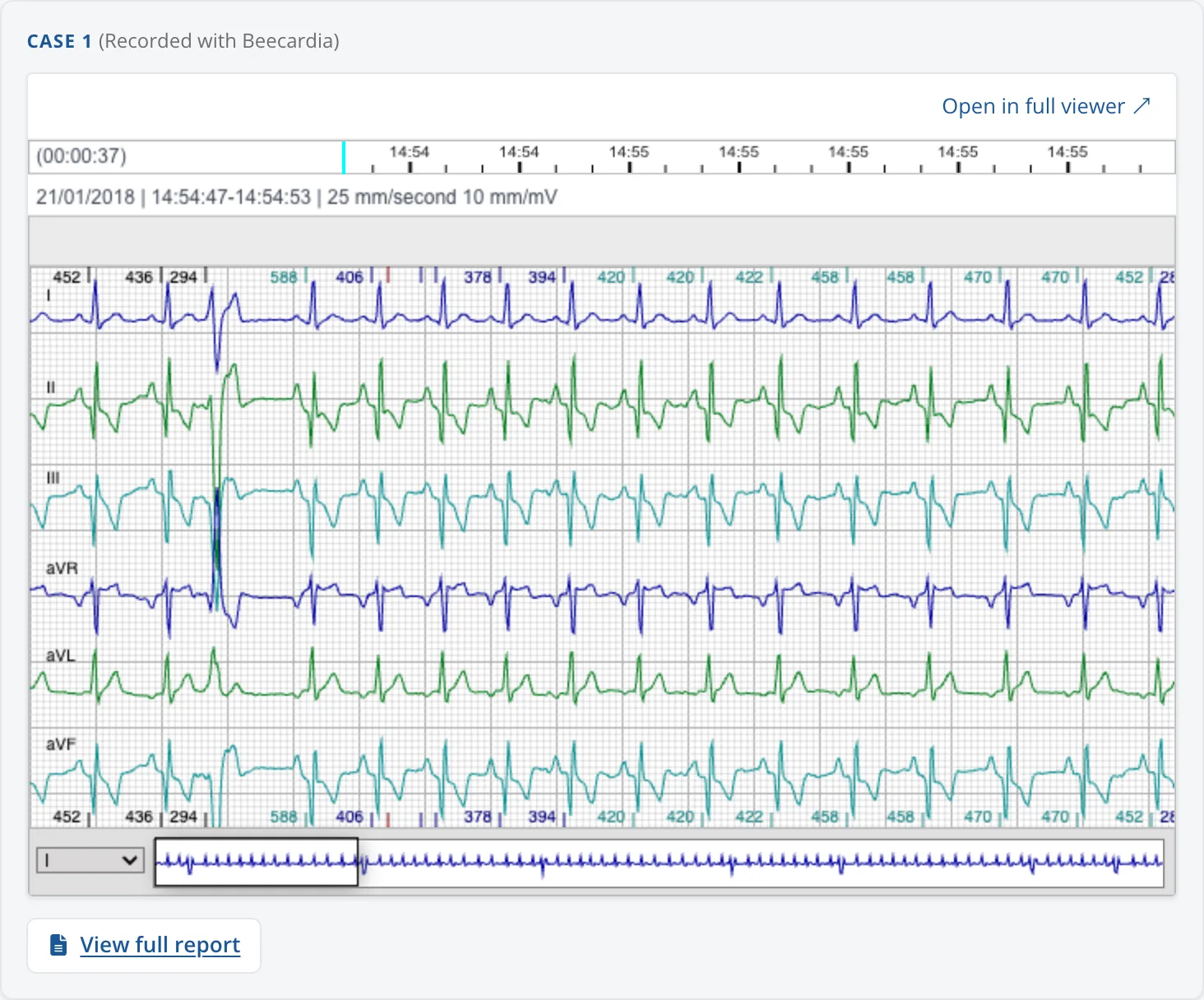
- Real cases, real reports: Every recording you open in the Academy was recorded with Beecardia and reported by a veterinary cardiologist. The measurements you see are the cardiologist’s, and a case shown under atrial fibrillation is one the cardiologist diagnosed as atrial fibrillation.
- Practice in the real viewer: Every case opens in the same online ECG viewer you use in your Beecardia account, so you can scroll, change paper speed and amplitude, and measure.
- Everything is connected: A quiz question takes you to the rhythm’s entry in the ECG Atlas, and from there to its learning guide, more quizzes and a simulation. You can learn the concept, see it in a real ECG, and then explore how the rhythm is generated.
What’s Inside
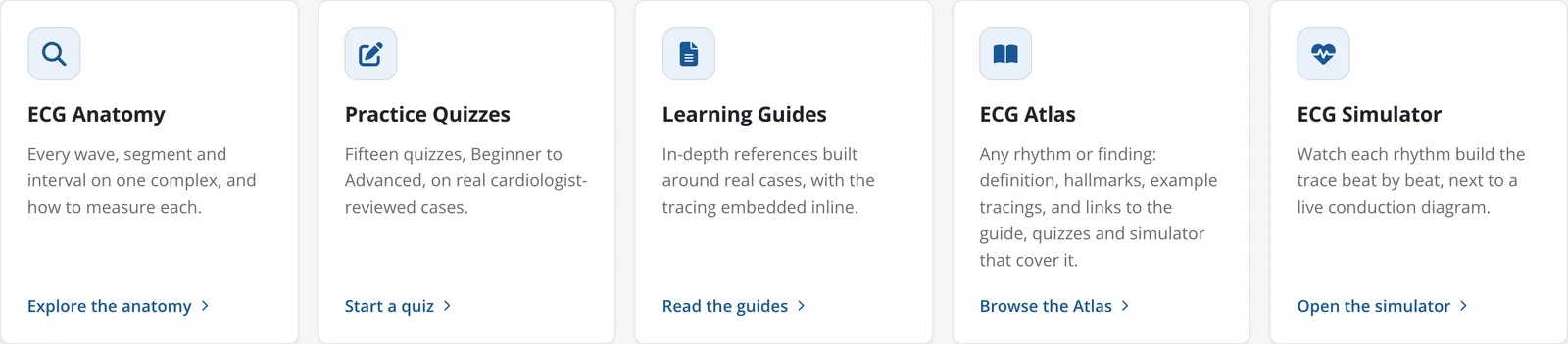
The Academy has five sections. You can follow them in order or jump straight to what you need.
ECG Anatomy
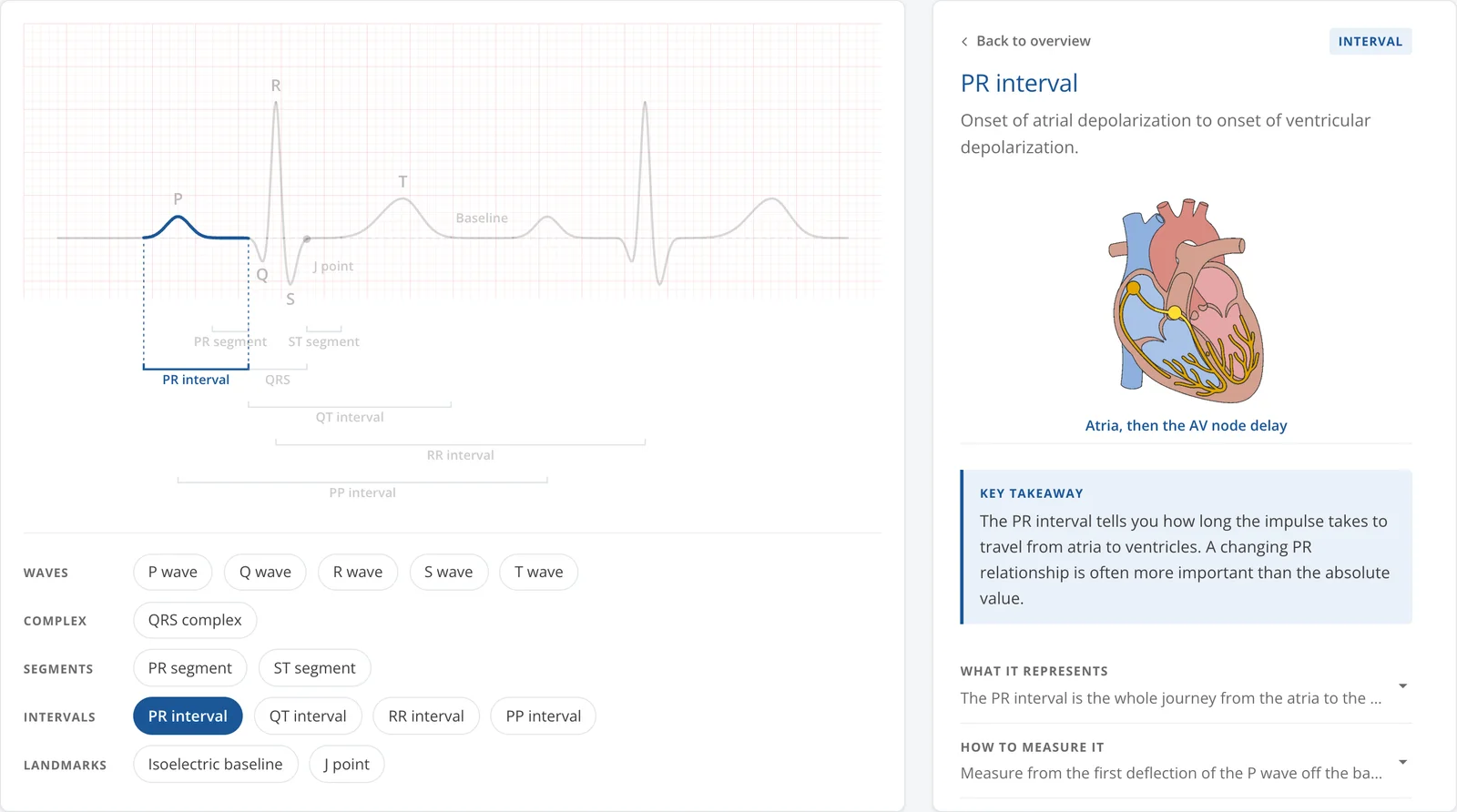
Refresh the fundamentals. ECG Anatomy shows a single cardiac cycle with every wave, segment and interval labelled. Click any of them to see what it represents in the heart, how to measure it, and which abnormalities to look for.
Practice Quizzes
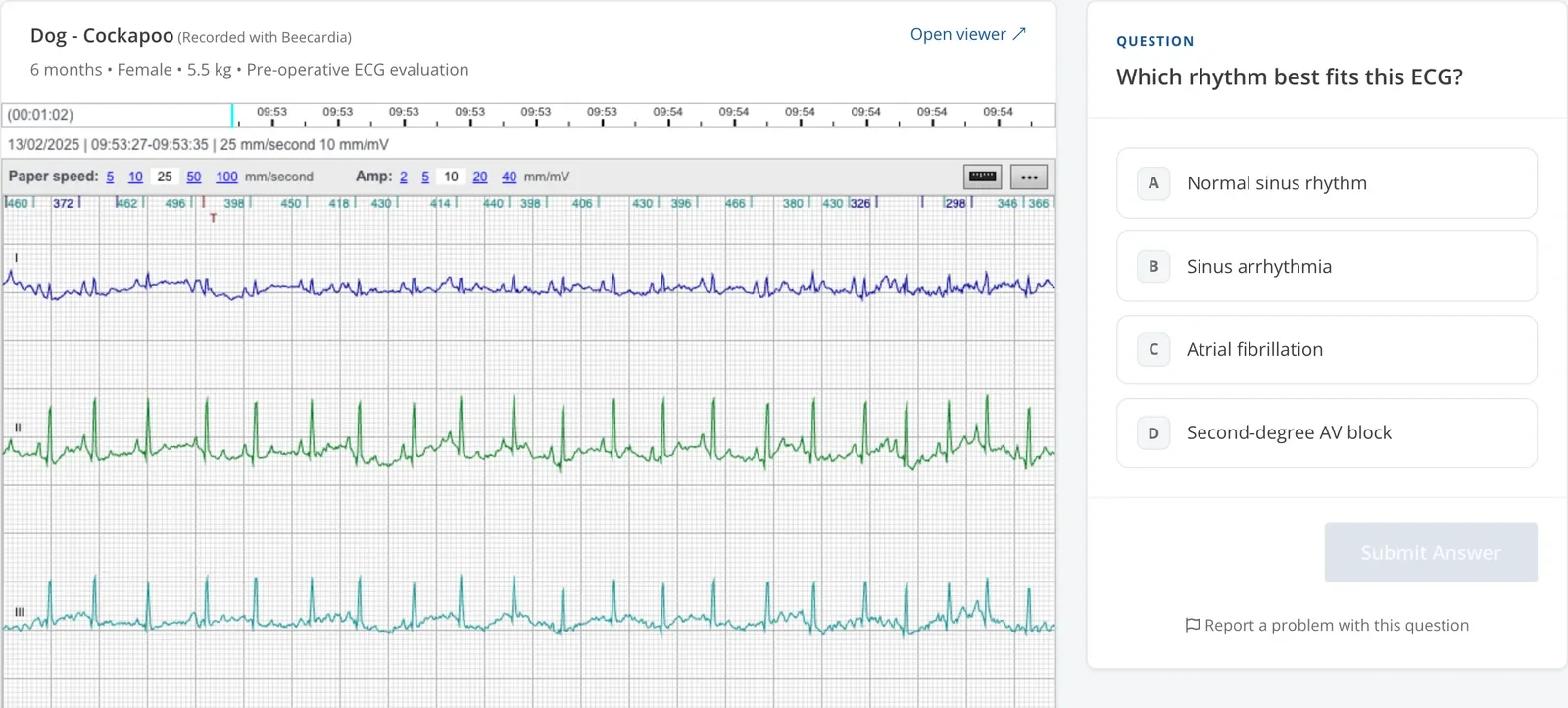
The heart of the Academy. Test yourself on 150 questions based on real veterinary ECGs. Practice Quizzes offers 15 quizzes in three levels - Beginner, Intermediate and Advanced. Each quiz has 10 questions and takes about 10 minutes.
- Every question shows a real ECG with the patient’s details, and the case history where there is one - the clinical context you would typically have when interpreting an ECG.
- Review the recording in the embedded viewer, pick your answer and submit.
- You get immediate feedback with an explanation, based on the veterinary cardiologist’s report for that case.
You’re not memorizing ECG patterns - you’re practicing the same interpretation process you use in the clinic. Beginner quizzes start with the questions that matter most in general practice, such as "Is the Rhythm Normal?" and "Fast or Slow?", and the levels build up to AV blocks, ventricular arrhythmias and clinical decision making.
Learning Guides
Go deeper into the arrhythmias you are most likely to encounter in practice. Learning Guides are in-depth references on APCs, VPCs, SVT, VT, atrial fibrillation, AV block and bundle branch block, written by Dr. Dan G. Ohad, DVM, Ph.D., ACVIM (Cardiology), ECVIM-CA (Cardiology).
Each guide combines explanation with real cases: the tracing is embedded right in the text, alongside the cardiologist’s measurements and the full report.
ECG Atlas
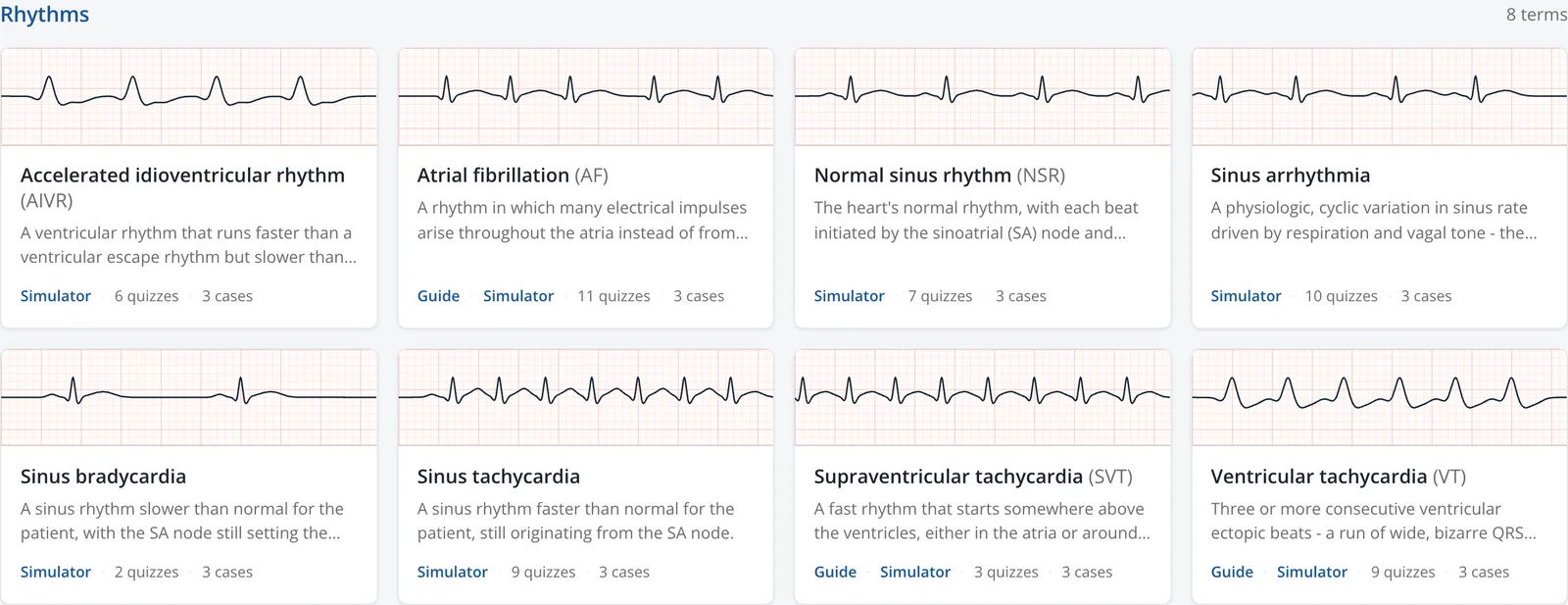
The ECG Atlas is the quick reference for the moment you need a reminder. It covers 25 rhythms and findings, from sinus rhythms and ectopy to conduction disturbances and waveform findings. Each entry gives you:
- A short definition, the key ECG features, common causes and why the finding matters.
- A schematic tracing drawn over a normal rhythm, so the difference stands out.
- Real example cases, each one reported with that finding by a veterinary cardiologist, plus links to the guide, the quizzes and the simulator scenario that cover it.
ECG Simulator
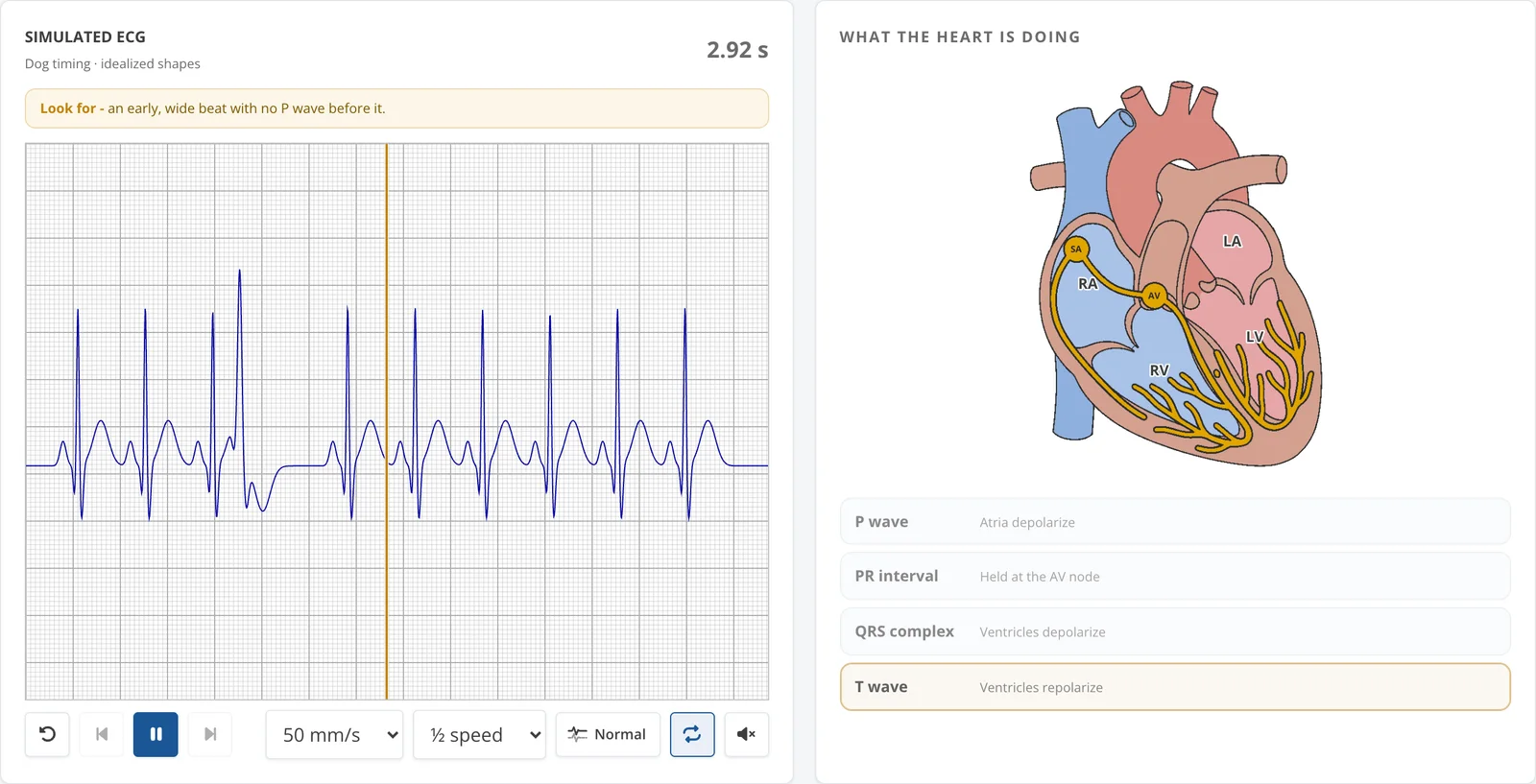
Sometimes a rhythm only makes sense once you see where it comes from. In the ECG Simulator you pick a scenario - from normal sinus rhythm to VPCs, atrial fibrillation or third-degree AV block - and watch the trace being drawn beat by beat, next to a heart diagram that shows the impulse travelling through the conduction system.
You can switch between dog and cat timing, slow the playback down, step from event to event, and overlay the normal trace for comparison. The simulator is a teaching model with idealized shapes, so it is the place to understand the mechanism before you go back to the real recordings.
How to Get Started
There is nothing to install and nothing to sign up for. You can get started in about 15 minutes:
- Open the ECG Academy from the main menu of our website.
- Take five minutes with ECG Anatomy to refresh the waves and intervals.
- Try the first Beginner quiz, "Is the Rhythm Normal?".
- Missed a question? Look the rhythm up in the ECG Atlas and follow the links to its guide and simulation.
Looking for something specific? The search box at the top of every Academy page finds rhythms, guides and quizzes by name.
It’s a Beta - Help Us Shape It
The ECG Academy is live now, and it will keep growing with more cases, more quizzes and more guides. Your feedback decides what comes next.
Found a question that is unclear? Every quiz question has a "Report a problem" link. Have an idea for a topic we should add? Send us your feedback or email us at support@beecardia.com.
Ready to try it? Open the ECG Academy and see how you do on your first quiz.